

Understanding as Resistance
Why complexity still matters in a world drawn to easy narratives

Days at Lago de Atitlán have a quietness to them that leaves more time for reading and watching films. Over the last week, I’ve streamed two documentaries: Between the Mountains and the Sky and Katô: Dreams of Dark Earth.
In Between the Mountains and the Sky, we follow the story of Maggie Doyne, a humanitarian who after a post-high school gap year chose to stay in Nepal and build a children’s home and school with Tope, a young Nepali man who had been an orphan himself. Across 20 years of footage, we witness her grief, love, and an unwavering commitment to children the world had largely overlooked.
In Katô: Dreams of Dark Earth, the Munduruku people in Brazil’s Tapajós River use cameras to document the destruction of their ancestral land by illegal miners and loggers. They use storytelling as a way of protecting memory, land, and survival.
The films emerge from very different places and struggles, yet they share the same conviction: stories can resist erasure. They insist that people cannot be reduced to headlines, statistics, or simplified narratives.
Watching them, I realized that long before I had language for it, I was drawn to that same conviction.
When I began my PhD, there was no comparative education track in my program, so I built one as best I could. As a single parent with a full-time job, I needed a university in my city, and fortunately the program allowed enough flexibility for me to shape it around my interests.
I took classes on the social and philosophical underpinnings of education, multicultural issues, and cross-cultural education, but it was the research courses that deeply resonated with me and were later the ones I taught as a faculty member.
Qualitative research felt immediately familiar. I have always been fascinated by people and how they understand their lived experiences, and qualitative inquiry gave that instinct a framework. It understands human experience as socially constructed, interpretively rich, and deeply shaped by context
The work felt like a continuation of what literature had already taught me in my undergraduate and graduate programs: read closely, notice the gaps, take note of what’s not being said, follow the argument, and ask better questions from different angles.
I remember sitting in my first qualitative research course thinking: my god this is already how I move through the world. I wanted to understand the why beneath the surface, the texture of an ordinary life, the kind of inquiry that begins without certainty and allows you to follow the research to your own conclusions.
To teach the true spirit of inductive reasoning, we were tasked with finding an observation site for the semester where we’d spend an hour each week observing, taking notes, narrowing our focus, and drawing conclusions.
I chose the St. Louis Art Museum, where they had comfy black couches in one of the main galleries. I sat there week after week watching people look at the paintings. I paid attention to how quickly they moved, where they lingered, the level of noise, the traffic through the room, the workers, the children, the silences.
I loved that the assignment asked us not to begin with conclusions, only attention.
When it came time to share our topic for our research project, I said I wanted to conduct an ethnographic study on girls’ education in India. Most ideas shared in class were local and manageable. Mine was not.
I still remember the professor repeating my idea back to me, as if it was a question. You want to go to India and research girls’ education? I heard doubt in the question, which only sharpened my resolve. “Yeah,” I replied, thinking, That’s exactly what I’m going to do.
And eventually, I did.
Two years later, after writing my dissertation proposal, I traveled to Bihar, one of the Indian states with some of the lowest social indicators, especially as they pertain to girls. Child marriage rates were high, and literacy, school attendance, and completion rates were low.
Yet it was also a moment of possibility. The Right to Education Act had recently passed, and there was real national attention on expanding education, particularly for girls.
The work led me to informal education programs for girls in the slums of Mumbai, to schools in Cambodia, and later to programs in St. Louis serving newly arrived immigrant students learning English before entering traditional classrooms.
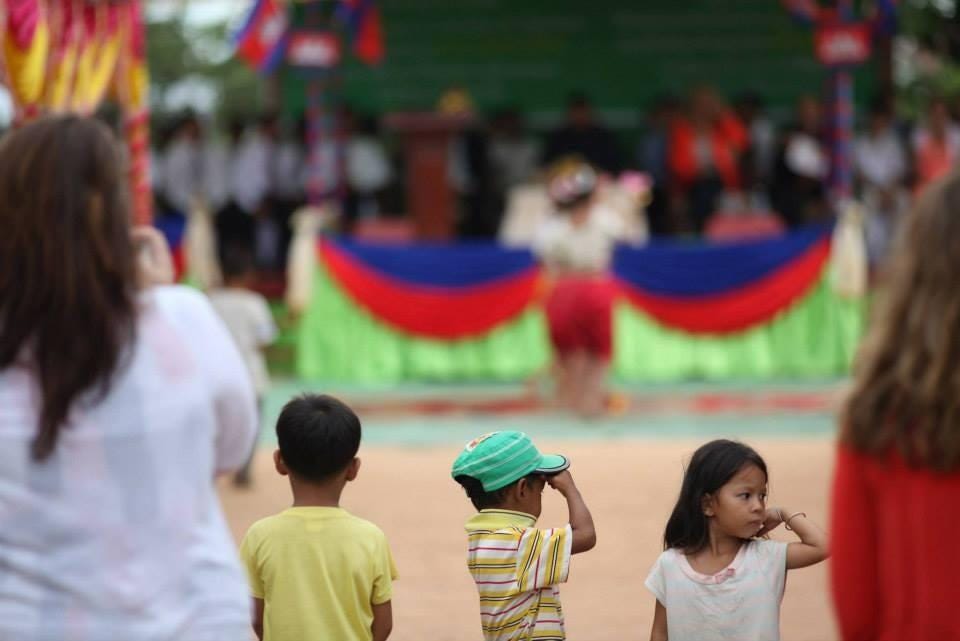
The locations changed, but the essential question remained the same: how do people make meaning inside the worlds they inherit, and what helps them imagine something beyond them?
Understanding culture was at the heart of my academic work, and it remains the essence of what I do now.
When I made the decision to leave academia, it wasn’t because I stopped loving research. If anything, I left because the research mattered so much–the stories, the women, the lives behind the data–and I wanted those stories to reach beyond academic journals.
I am a researcher, but I am also a storyteller, and I love sharing people’s stories.


Narrative writing has become one of the clearest continuations of that work. I still approach people, places, and ideas the same way: with curiosity rather than conclusions, with openness to complexity, with a desire to understand context, with a willingness to notice my own assumptions before letting them settle into judgment. What once felt like research training now feels equally like an ethical practice.
Given the state of the world, I sometimes feel pressure to be louder in my anger, but I have come to see that my approach is its own kind of resistance, and it’s the one that feels most natural to me.
At a time when public discourse reduces people to categories—us and them, simplified identities, easy narratives—I remain interested in what refuses simplification: context, contradiction, humanity.
Understanding is its own kind of force. It rebuilds what division erodes. It reminds us that culture, in all its forms, is not something to fear but something to move toward with wonder.
That belief did not begin with a dissertation or a methodology course. It began with literature, with learning to read closely and ask better questions. Research gave it rigor. Fieldwork gave it humility. Writing gives it a place to live.
The foundation was always there; it simply took time to reveal itself.
Nice piece, Jen. As always.
My first postdoc advisor always told us, "get your questions right. You answer what you ask."