

On Spaciousness
A reflection on ethnography, consciousness, and the practice of remaining open to what unfolds

Yesterday, instead of just cutting through the Central Park in Antigua on my way home, I found an empty spot on a bench next to a young mother who carefully balanced a large bag of birdseed on her head and a baby on her lap. She smiled at me briefly before shifting her focus back to her baby.
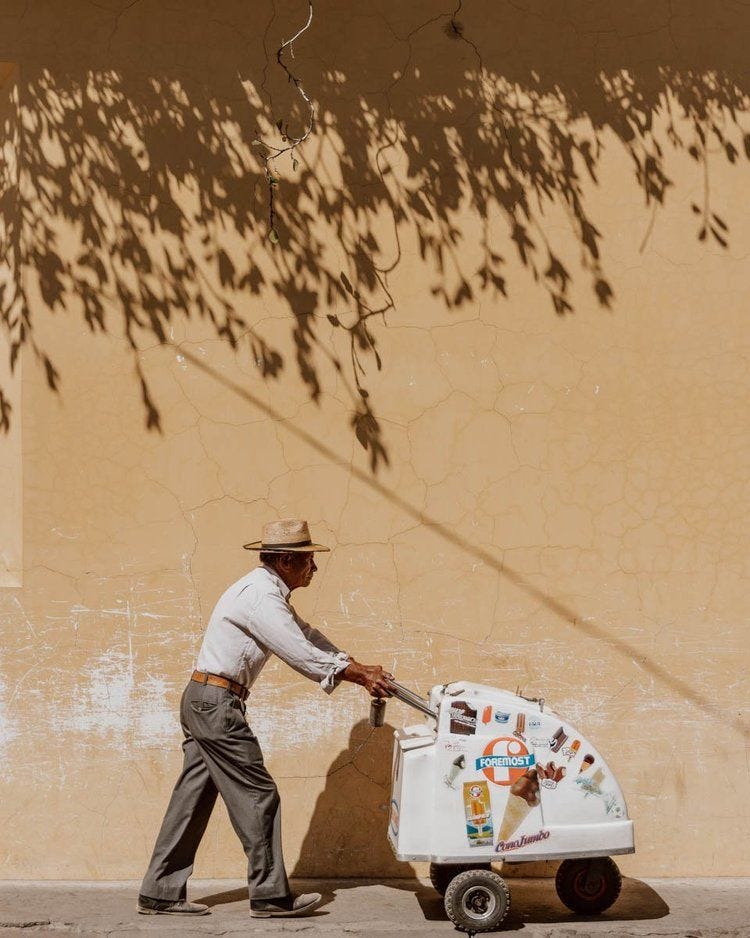
Even in the middle of a weekday, this park bustles with activity. Small children feed the pigeons and scream when they take flight as someone walks down the path. Bubbles float in the air and men blow into bamboo flutes they are selling, while an ice cream seller–dressed sharply in a tucked button-up shirt and khaki pants–leans against his cart, ringing a bell with one hand and scrolling on his phone with the other.
“This place is so alive,” someone recently said to me after arriving from the U.S., where strip malls with the same box stores evoke a sort of sameness that makes it easy to forget that such richness and color and life can exist.
I take out a notebook and scribble down what I’m observing. The people, the laughter, the low murmur of conversations, the meals eaten on park benches, and at the center of it all, a large fountain–Fuente de las Sirenas or Fountain of the Sirens–with four mermaid-like figures with water sprouting from their breasts. Such a provocative fountain I think to myself, especially in a community that is known for being religious and conservative. Later, I read that the fountain was inspired by a local lore (and a fountain in Bologna, Italy) and represents wet nurses, a symbol of motherhood and fertility.
As I look around, I realize that I’m one of only a few people sitting in stillness without a phone or another person to distract me. As a qualitative researcher, I’m accustomed to approaching experiences and situations with curiosity, looking for the nuances, trying to discern meanings and understand the why and how beneath what is visible.
The work honors stillness, deep listening, and continually reflecting on what I’m witnessing. When I began this work nearly 20 years ago, it felt innate, like a natural extension of how I already move through the world. Sitting in the park now, I find myself wondering what makes this place feel so alive. The questions are familiar, though there is no project attached to this moment–no interviews to conduct, no field notes to code, no report to write. I’m simply sitting, noticing, and allowing myself to be present with what is unfolding around me.
I recently started reading Attuned: Practicing Interdependence to Heal Our Trauma––and Our World, where author Thomas Hübl writes that “when we practice stillness, a deep feeling of interior spaciousness can arise.” When we quiet the constant activity of the mind, we create room for something deeper to emerge. This approach asks us to encounter life as it is––without analysis, judgement, or the immediate need to make sense of what we’re experiencing.
I couldn’t stop thinking about these parallels yesterday as I worked through a list of student questions ahead of speaking to a graduate leadership course today on intercultural communication and interaction.
The questions covered everything from leadership and cultural adaptation to global citizenship and personal growth. Students wanted to know what I’ve learned from living and working around the world, how I establish trust across cultures, what experiences have changed me, and what advice I would offer to those hoping to develop a global mindset.
As I read through them, I expected to find myself reflecting on countries, projects, and professional experiences. Instead, I found myself reflecting on the relationship between openness and presence.
After nearly two decades of living, working, researching, and teaching across cultures, the lessons that feel most important are surprisingly simple and are ones I use when I’m doing research: stay open, listen more than you speak, stay curious longer than feels comfortable, resist the urge to make assumptions, and allow people to reveal themselves rather than deciding who they are based on your own expectations. There’s a reason ethnographic research requires time–you can’t rush meaning, and you can’t extract isolated experiences without understanding the deeper complexities that shape them.
In many ways, the principles that guide qualitative research mirror those Hübl describes when he writes about spaciousness. Before we can understand another person, another culture, or even ourselves, we have to create enough space to truly encounter what is there.
Lately, I’ve realized that this lesson extends beyond my work. The more intentional I’ve become about the boundaries I hold, the more spaciousness I’ve created in my own life. By letting go of relationships, commitments, and expectations that no longer align with who I’m becoming, I’ve made room for something else to emerge.
What I’ve found is that as more spaciousness opens, life begins to reorganize around it. New ideas, thoughts, and words arrive alongside deeply aligned friendships; conversations deepen, and opportunities emerge in ways that feel unexpectedly coherent.
Sitting in the park, watching life move around me, I wonder if this is what surrender actually looks like—not withdrawing from life, but creating enough spaciousness to receive what is already trying to find us.
After reading last week’s post about surrendering, one of the students posed a version of this question: how do we know when commitment has devolved into attachment?
It took me some time to think about my answer, but what I can discern is that commitment is devotion to a path, and attachment is devotion to a particular destination––and wow, have I lived the shift between these two.
Commitment feels expansive and curious because you’re willing to meet what unfolds. Attachment contracts that space. It narrows attention toward a fixed outcome, and in doing so, even meaningful work or relationships begin to feel tense and constricted.
It has been a lesson of a lifetime to approach my own life with the same openness that I reserve for my research–not to force meaning too quickly or rush toward conclusions, but to stay with what is unfolding long enough for it to reveal its own shape. To trust that understanding comes not from tightening control, but from remaining in conscious awareness of experience as it is.
"Commitment is devotion to a path, and attachment is devotion to a particular destination."
I have read that three times now.
I have held on to outcomes so tightly that the thing I loved most about the path disappeared entirely. The grip was the problem. I just didn't have language for it until now.
What strikes me about your park bench moment is the notebook. The researcher in you never fully rests. But neither does the human. You were simply sitting and noticing. That is its own kind of devotion.
Commitment to the path, not attachment to the destination…. That really is it. Thank you.