

Living Abroad, Learning Solitude
What repeated arrivals teach you about friendship and being alone

When you imagine a life abroad, you think about movement, languages, unfamiliar streets, new routines, and the people you’ll meet along the way. You imagine adventure, freedom, and the possibility of reinventing yourself. You don’t predict that life abroad will also be shaped by solitude—how much effort it takes to build connection, and how hard it can be to say goodbye when it’s time to leave.
When I first left the U.S. and found myself in Guatemala, I was so eager to meet people. I went out more than I normally would and hung out with whoever happened to be around. Some of the people were like-minded, but many were not. The lake is small enough that friendships happen without much work. It’s more about proximity.
Mexico City was different. The city was larger, less forgiving, and friendships didn’t arrive by accident. Because of my interest in art, many of my first connections began through artists.
One night, a friend who is a muralist was speaking on a panel, and I decided to go even though I didn’t really feel like going out. I knew the talk would be in Spanish and that I would only understand a fraction of what was being said.
But living abroad teaches you that if you wait until you feel fully comfortable, you may never fully step into your own life.
The talk ended with an open bar and long conversations. It was the night I met lots of people and formed a lasting friendship with Hugo, an architect from Hidalgo. I still think about how easily that night could have not happened and how I wouldn’t have him in my life if I had listened to the part of me that wanted to stay home.
In many ways, that feels like the perfect summation of what living abroad is like. It’s showing up when you don’t feel like it, when you know you won’t understand what is happening around you, when there is a real possibility the evening may leave you feeling more isolated than connected. Much like Nick in The Great Gatsby when he expresses feeling “within and without” at the same time.
I met one of my best friends at an art exhibit, though we didn’t speak that night. I noticed her and thought she looked interesting, but I didn’t know if she spoke English, so I said nothing. Later, when the exhibiting artist shared photos of the event, I noticed the woman and sent her a message. We chatted a bit, and when she mentioned that she’d have work in another exhibit, I made sure to attend, and Hugo agreed to go with me.
By the time I arrived in Paris, I was more selective. Before, I thought the work was simply saying yes often enough, but later, I realized that yes only mattered when paired with more discernment.
Some friendships formed naturally at coffee shops. (I swear coffee shops are the best places to meet people.) Others began from a post I wrote in a Facebook group for women in Paris. I jokingly referred to it as a dating ad for friends. I explained that I had been living in Mexico, that I was a professor turned writer, and shared a few of my interests.
The response was overwhelming, and my calendar filled with coffee dates and afternoon drinks. Some meetings were forgettable. One woman invited another friend to join up later and asked me to lie about how we met because she didn’t want her friend to know we had connected through Facebook. “She’s judgmental,” the woman explained, which made me wonder why she’d have such a friend. It goes without saying I didn’t meet up with her again.
And there was Carrie, a poet from Alabama. I liked her instantly. Our conversations seemed to bypass small talk and move quickly into writing, translation, academia, literature, among other topics. They’re the kinds of conversations that make you feel grateful to have met someone who speaks a language you care deeply about.
Despite these lasting friendships, there have been many that fall through the cracks. Sometimes the connection just wasn’t there, or perhaps I didn’t stay long enough for anything to deepen.
Eventually, after enough arrivals and departures, you stop putting forth the same effort to form friendships. I’ve spent months in Crete, Spain, and Buenos Aires where entire days passed with almost no conversation beyond ordering coffee. That made for quiet days. At times it felt lonely, though now I think of it differently.
I’ve always been a person who didn’t mind being alone, even though I’m an extrovert. But earlier in life, I was rarely alone in any real sense. I had two kids and was always thinking about schedules, needs, responsibilities.
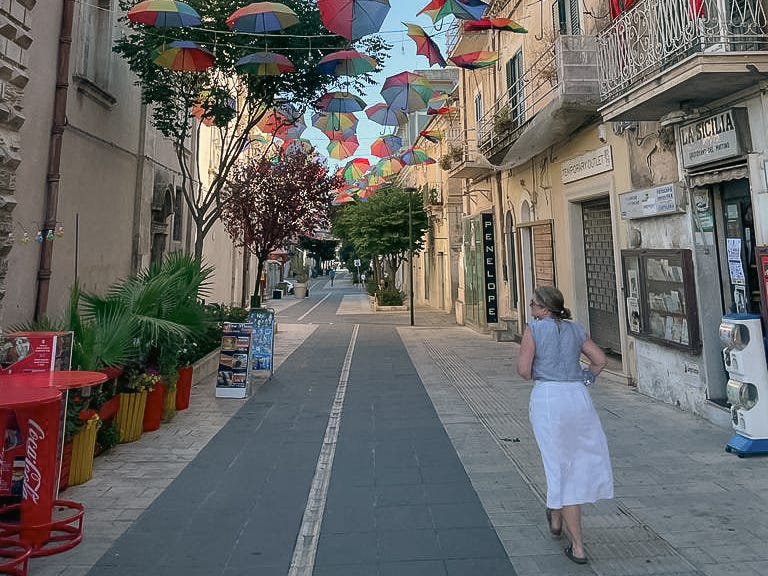
Travel forced me to learn a different kind of solitude.
Most days I am alone. Some days the only person I talk to in person is the barista taking my coffee order. I journal, dance in the kitchen when I cook, read, go for long walks, do yoga, and sometimes even play around with watercolor paints in the evening.
I once interviewed a 90-year-old woman for an article I was writing, and when she learned that I was single, my kids were grown, and I didn’t have any pets, she asked, “So everyday you get to wake up and do whatever you feel like doing?”
“More or less,” I told her.
“That is a gift,” she said. “Don’t give that away to just anybody.”
There are the people who remain constant–Katie, Lindsey, my mom, Emma, and Oliver. Distance and time apart do little to change that; most days are still threaded with voice notes or conversations with some combination of those five people.
No one explains that living abroad will teach you two opposite things at once: how to keep entering unfamiliar spaces in search of connection, and how to stop treating solitude as something that must always be solved.
The friendships matter, of course, but some of the deepest change happens in the quieter hours, when unfamiliar places begin to ask less of you because you have learned to inhabit them differently.
Jen - I find myself not wanting your essays to end ;)