

Before the First Sentence
Twenty-six years of teaching writing taught me that every sentence begins with paying attention.

Last week, I invited a new friend over for coffee and pastries from one of my favorite cafés. We settled in at my kitchen table, and somewhere between our second cups of coffee and the last pastry on the plate, nearly six hours had passed. It was one of those rare afternoons when conversation carried us so completely that neither of us noticed the time.
My friend is a poet, and our conversation wandered between words, writing, and the nuanced ways each of us approaches language. She shared that she’s been trying to write more exactly because she realized she’d been using metaphor to avoid saying what she really meant. She could circle an idea, allude to it, wrap it in beautiful language, but not always name it directly.
I smiled because I’ve been trying to do the opposite. I’ve been trying to allow more emotion onto the page. Less explanation. More feeling.
I’ve found myself returning to that conversation all week because it made me realize how much my writing has changed over the past year. Or perhaps it’s more accurate to say that I’ve changed, and my writing has simply followed.
I began teaching writing–English 101 and 102–in 2000, as a young graduate student. I still remember walking into that first class, terrified that my students, many of whom were nearly my age, would somehow discover I had no idea what I was doing. I’m sure I made many blunders, but somewhere between teaching first-year composition and pursuing my master’s degree in literature, I fell in love with language–not only what words mean, but how they sound, how they feel in your mouth, and how the right word can make a sentence come alive.
Twenty-six years later, I still get a small thrill when I notice the rhythm of a sentence or the precise weight of words like quintessential or copacetic. Language can be so unbelievably sexy. What has changed isn’t my love of words but my relationship to them.
Sometimes I wonder if I move through the world the way I do because I am a writer, or whether I became a writer because I’ve always moved through the world in this way. I don’t know the answer, but what I do know is that the way I pay attention has shifted over the past year.
The more I meditate, the more silence I seek, the more I notice myself writing from a different place. Living in Guatemala has slowed something inside me. My days feel less crowded, not because there is less to do, but because I’m no longer filling every empty space with noise. Maybe this season of stillness is exactly what I needed—not only to write differently, but to become different.
I’ve always considered myself an extrovert, but lately I find myself turning inward. These days, I’m happiest with long stretches of uninterrupted time to read, think, and write. When I wander through the streets of Antigua, I find myself slowing down enough to observe. I carry a small notebook in my bag and jot down snippets of conversation, gestures, and questions. I photograph shadows stretching across cobblestone streets, the woman selling textiles on the same patch of sidewalk every morning, the dog asleep beneath the fruit cart, and the afternoon light catching the chipped paint on a wooden door.
When I begin teaching a new writing course, I have my students fill out a questionnaire about themselves as writers. I ask where they like to write, what they struggle with, and what kind of writing feels most natural to them. I answer the same questions because I want them to know that every writer is still learning the craft, that we’re engaged in the same work. I’ve simply been at it longer.
I also show them my own drafts—pages covered in arrows, crossed-out sentences, and notes in the margins. Students often imagine that more experienced writers simply sit down and produce beautiful prose. I want them to see that writing is rewriting and that the first draft is simply the place where thinking begins.
During my PhD, I found myself drawn to qualitative research. The methodology emphasizes careful observation, deep listening, and a willingness to sit with uncertainty before drawing conclusions. It asks researchers to notice before they interpret. The classes weren’t teaching me a new way of seeing; they were simply giving me academic language for something writing had already been teaching me for years: attention comes before understanding.
Over time, I’ve realized that attention isn’t simply part of my writing process. It’s how I move through the world.
David Sedaris once joked that he feels sorry for people who don’t write because they simply have to endure difficult situations. Writers get to write about them. Everything becomes material.
I think about that often when my travels don’t go according to plan. Somewhere between delayed buses, missed connections, and unexpected detours, I usually catch myself smiling and thinking, Well, at least this will make a good essay.
The longer I write, the more I suspect that writing begins long before we ever put words on the page. It begins with paying attention–to the conversation that lingers in your mind for days, to the rhythm of a sentence, to the weathered doorway you almost walked past, or to the silence that slowly reshapes the way you think.
Lately, I’ve realized that if I want to continue writing this way, I have to protect the conditions that make it possible. I’ve intentionally created more space in my days, but my phone continues to disrupt. Messages arrive from different corners of the world around the clock. The interruption is brief, but finding my way back into that train of thought is not.
So I’ve decided to silence my phone for the month of July. Perhaps longer. It’s not because I want less connection, but because I want more presence. I want to give my attention back to the things that nourish it: books, long walks, quiet mornings, and the slow work of finding the truest sentence I can.
When I think back to that afternoon around my kitchen table, I realize my friend and I were talking about more than writing. She was searching for more exact words. I was searching for the courage to let my words carry more feeling. On the surface, those seem like different pursuits, but I suspect they’re rooted in the same practice.
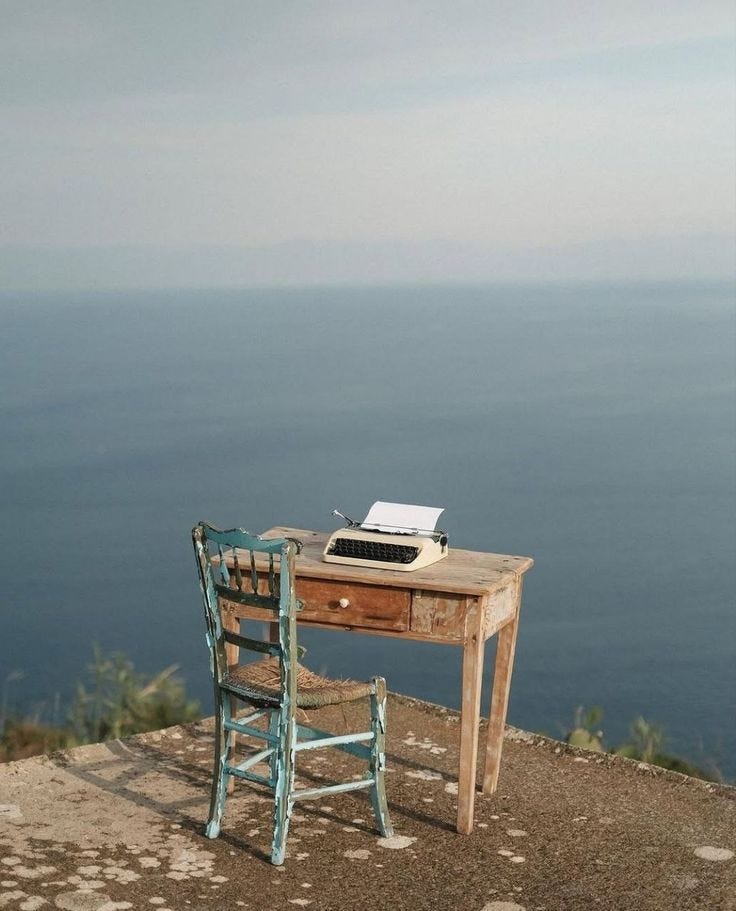
Before words ever reach the page, they begin with noticing.
As part of my job, I'm required to take technical policy guidance and craft it into something that is practical. My colleagues think that I just need to read it all and then start writing. What I find is that I need to let it all just circle around in my head, sometimes for weeks, before I can craft something that is real. These ideas need to come and then incubate with other things to create the space where I can then write something useful. None of my colleagues understand this and why it sometimes "takes too long."
Love this. I could talk forever about the internal "hows" around writing. For me it's like a song I hear in my head that I have to capture in words. I feel like I can hear the rhythm that the sentence is supposed to have, given the prior one, and the next one. The words are just sort of there. It's a mysterious process and I am not sure that I am entirely in charge of it. 🙂 Because sometimes stuff comes out of me that I never knew was there. (Lol, that last sentence is a little too graphic! It's not always poetic but there it is! 😅).